

♥ Wishlist




Envelopes are a simple but essential part of mailing, document organisation and personal correspondence. The right envelope can help protect its contents, present documents neatly and make routine mailing more efficient. For Canadian shoppers, the most useful choice depends on what you need to enclose, the dimensions of the contents, the level of protection required and how the envelope will be sealed.
This category brings together a broad selection of envelopes designed for different purposes. The products listed on the page include standard business formats, window envelopes, catalogue envelopes, kraft envelopes, coin envelopes, padded mailers, legal-size options, invitation envelopes, security envelopes and durable Tyvek styles. You can also find larger mailing formats for catalogues, reports and documents that need more room than a conventional letter envelope.
Size is one of the first details to check before buying. Smaller formats can be useful for cards, notes, invitations, coins and small parts, while business envelopes are designed around common letter-mailing requirements. The page includes No. 10 business envelopes measuring approximately 4.125 x 9.5 inches, as well as A2-style envelopes around 4.375 x 5.75 inches. Larger 9 x 12, 10 x 13 and 10 x 15 inch formats are represented for documents, catalogues and bulkier contents.
When comparing sizes, measure the item you intend to place inside rather than choosing an envelope based only on its name. Allow enough room for the contents to slide in without excessive bending or compression. For folded letters, invoices and standard paperwork, a business envelope can be appropriate. For booklets, reports or larger documents, a catalogue or open-end envelope may provide a better fit.
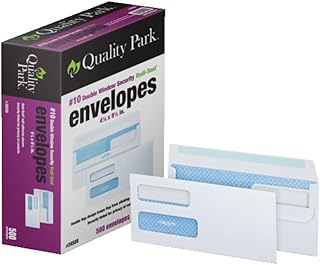
Business envelopes are a practical choice for letters, invoices, statements and routine office correspondence. No. 10 formats are widely used for folded documents and are available with different closure and security features.
Window envelopes include a transparent section that can display an address printed on the enclosed document. Security-tinted versions are designed to make the contents less visible from outside, making them useful when mailing information that requires additional privacy.
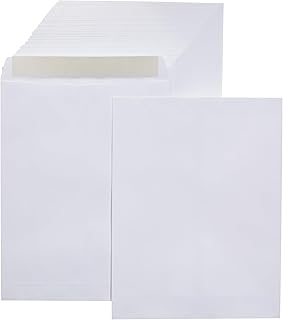
Catalogue envelopes offer more space for booklets, reports, catalogues and thicker documents. Kraft versions provide a sturdy paper format and are available in larger sizes and different closure styles. Some products use gummed flaps, while others feature self-sealing or peel-and-seal closures.
Coin envelopes are compact options for organising coins, jewellery, small parts and other tiny items. They can be useful in offices, workshops, craft areas and home organisation where small pieces need to remain together.
Padded envelopes add cushioning around their contents and can be useful for small electronics, accessories and other items that need more protection than a standard paper envelope. Rigid mailers and durable Tyvek options provide additional choices when resistance to bending, tearing or moisture is important.
Envelope construction can affect how practical an option is for a particular task. Paper envelopes are suitable for everyday correspondence, while heavier kraft paper can be useful for larger documents and storage. Some listings use specified paper weights or GSM ratings, which can help you compare the thickness and structure of different products.
Closure style is another important consideration. Traditional gummed envelopes use an adhesive surface that is activated with moisture. Self-seal envelopes use an adhesive strip, while peel-and-seal designs generally use a removable protective backing. If you are preparing a large number of mail pieces, a quick and convenient closure can save time.
At home, envelopes can be used for greeting cards, invitations, paperwork, keepsakes and small-item organisation. Offices may need business envelopes for invoices, statements, correspondence and forms. Businesses sending catalogues, reports or larger documents can benefit from open-end and catalogue formats. For shipping-related tasks, padded, rigid, waterproof or tear-resistant options may provide additional protection depending on the contents.
Whether you are preparing business correspondence, organising paperwork, sending invitations or packaging larger documents, choosing the correct envelope can make the task easier. Consider the contents first, then compare size, material, closure, protection and pack quantity. With a broad selection of envelope formats available for Canadian shoppers, you can narrow your search according to the type of mailing or storage task you need to complete.
Use the available product listings to compare envelope styles and specifications before purchasing. Checking dimensions, closure type, material and quantity can help you select an option that fits your intended use without relying on appearance alone.
Find envelopes for everyday correspondence, office paperwork, invitations, document storage and mailing needs. The collection includes options in different sizes, materials, closures and formats, from standard business envelopes and window envelopes to catalogue, kraft, coin, padded and durable Tyvek options.