

♥ Wishlist
Compare 33 Greenworks Chainsaws for Canadian Homes & Outdoor Projects products in Canada. Reviews, ratings, pros, cons and buying advice updated for October 2026.
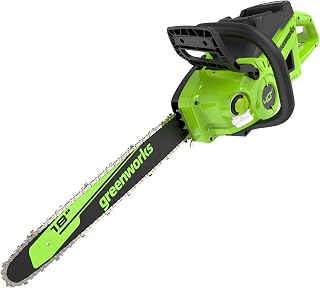


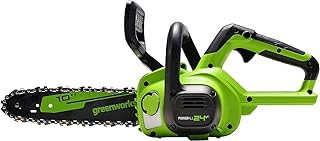
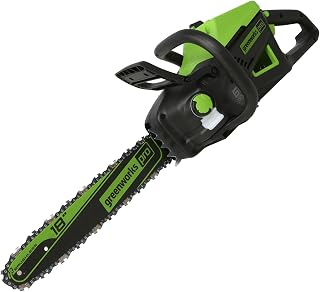


Choosing a Greenworks chainsaw is less about finding the most powerful model and more about matching the saw to the wood, cutting frequency, bar length, battery platform and type of property work you expect to handle. Greenworks offers cordless chainsaws across several battery platforms, including 24V, 40V, 60V and 80V, with bar lengths commonly ranging from compact 10-inch and 12-inch options to larger 16-inch and 18-inch models. Its Canadian range also includes both tool-only products and kits that include a battery and charger.
That variety makes comparison important. A homeowner trimming small branches has very different requirements from someone regularly processing storm-damaged trees or cutting substantial firewood. The right Greenworks chainsaw should provide enough cutting capacity without adding unnecessary weight, battery expense or handling difficulty.
For Canadian buyers, availability can also change by model and retailer. Greenworks Canada's current chainsaw catalogue shows multiple configurations across its battery platforms, so specifications, included accessories and current availability should always be checked before purchase.
Greenworks uses voltage platforms to distinguish major parts of its cordless outdoor power-tool ecosystem. The voltage number should not be treated as a simple measurement of cutting speed. It is one factor in the overall system, alongside motor design, chain configuration, bar length, battery capacity, electronics and the specific workload.
The 24V platform is aimed at lighter-duty cutting where compact size and convenient handling matter more than maximum cutting capacity. These saws can make sense for pruning, small branches and occasional property maintenance when the material being cut is within the manufacturer's stated capability.
A compact saw can be easier to control in confined spaces and less tiring during short jobs. However, buyers should not select a small model simply because it has a lower purchase price. If your regular work involves larger logs, storm cleanup or repeated firewood cutting, moving to a higher-capacity platform may provide a more appropriate tool.
Greenworks' 40V range occupies an important middle ground for homeowners. Canadian listings include 12-inch, 14-inch and 16-inch chainsaw configurations, with both brushless and other motor arrangements depending on the model. Some packages include a battery and charger, while others are sold as tool-only products.
A 40V chainsaw can be particularly attractive when the intended work consists of routine yard maintenance, branch removal, moderate storm cleanup and occasional cutting of smaller logs. If you already own compatible 40V Greenworks batteries, a tool-only configuration may also make more financial sense than purchasing another battery and charger.
The 60V platform is suited to buyers who want substantially more cutting capability without moving to the highest Greenworks voltage tier. Current Canadian listings include 16-inch and 18-inch chainsaw configurations, with several brushless options.
The 60V category deserves attention from property owners who regularly deal with larger branches, heavier storm debris or more demanding firewood preparation. An 18-inch bar can provide greater reach than a compact homeowner saw, although bar length alone does not determine how effectively a chainsaw handles a particular piece of wood.
Greenworks' 80V platform sits at the higher-capacity end of its cordless chainsaw range. Canadian listings include 16-inch and 18-inch brushless chainsaws, including configurations with batteries and chargers.
These models are worth considering when cutting performance and sustained capability are higher priorities. However, the largest or highest-voltage chainsaw is not automatically the best choice for every homeowner. Additional capacity can come with greater system cost and potentially more weight, so the saw should be selected according to the work rather than the voltage number alone.
Brushless motors are an important feature to compare across Greenworks chainsaws. A brushless design eliminates conventional motor brushes and is commonly associated with efficient electronic motor control, reduced mechanical wear in the motor and strong power delivery for cordless applications.
When comparing two saws, do not stop at the phrase “brushless.” Consider the complete specification package. Motor technology should be assessed alongside battery voltage, battery capacity, bar length, chain specification, weight and intended workload.
Bar length is one of the easiest specifications to understand but one of the easiest to misuse. Greenworks chainsaws in Canada are available with several bar lengths, including compact models and larger 16-inch and 18-inch configurations.
A longer bar can provide greater reach and cutting capacity, but it can also increase overall size and handling demands. A shorter bar can be easier to manoeuvre, particularly for pruning and routine garden work.
Do not select a chainsaw solely because its bar is longer. The correct choice depends on the diameter and type of material you intend to cut, the saw's rated capability and your experience level.
Battery voltage and battery capacity are different specifications. Voltage describes the electrical platform, while amp-hour capacity provides an indication of the battery's stored energy. A higher-capacity battery can potentially support longer work between charges, although actual runtime depends on cutting conditions, wood density, chain sharpness, operating technique, temperature and other factors.
Canadian Greenworks listings show chainsaw kits with different battery capacities, including configurations such as 2.0Ah, 2.5Ah and 4.0Ah batteries. Compare the battery included in the package rather than assuming that every saw in the same voltage family comes with the same battery.
This is one of the most important buying decisions for existing Greenworks users. A tool-only chainsaw may be a sensible option if you already own a compatible battery and charger. For a first-time buyer, however, a kit can be more convenient because the necessary power components are included.
Always confirm battery compatibility by model and platform. Do not assume that every Greenworks battery works with every Greenworks outdoor power tool simply because the brand name is the same.
If your primary requirement is removing small branches, pruning trees or handling occasional light garden work, prioritise compact dimensions, manageable weight and ease of control. A smaller Greenworks chainsaw may be more practical than a large 60V or 80V machine.
Buying substantially more saw than the job requires can make routine work unnecessarily tiring. Look for a bar length appropriate to the material you will actually cut and follow the manufacturer's operating limits.
For homeowners who need one chainsaw for a mixture of branch cutting, occasional fallen limbs and moderate property maintenance, the 40V range can be an interesting category to investigate. The current Canadian range includes several bar-length choices, allowing buyers to balance portability and cutting capacity.
If you already use other Greenworks 40V equipment, battery compatibility can make the platform especially convenient. If you do not own the battery system, compare the complete kit cost rather than the tool-only price.
Canadian weather can leave homeowners dealing with fallen branches and damaged trees after severe wind, snow or ice. For this type of work, cutting capacity, chain condition, battery availability and handling become more important.
An 18-inch Greenworks chainsaw may be more appropriate for demanding material than a compact pruning saw, but the machine should still be used only within its intended application. Never assume that a larger bar makes a chainsaw suitable for every tree or storm-cleanup situation.
Homeowners who cut firewood should consider the diameter and quantity of wood they normally process. Occasional small-diameter cutting can be handled differently from repeated processing of larger hardwood logs.
For regular firewood work, compare motor design, battery capacity, bar length, chain availability and ergonomics. A saw that is technically capable of a task may still be a poor choice if its battery capacity, weight or handling characteristics do not suit the duration of the job.
Owners of larger rural or semi-rural properties may benefit from comparing the higher-capacity 60V and 80V Greenworks ranges. These platforms offer larger chainsaw configurations, including 16-inch and 18-inch options.
The important distinction is not simply “more voltage equals better.” Instead, consider whether the additional capability justifies the increased system investment and whether you can comfortably handle the saw for the intended work.
Comparing Greenworks voltage platforms is useful because it helps narrow the range before you compare individual models.
Greenworks Canada's current catalogue lists multiple chainsaws across these platforms, so buyers should compare individual model specifications rather than treating every saw within a voltage family as identical.
The difference between a 16-inch and 18-inch bar can matter when cutting larger material, but it should be considered together with the saw's motor and chain system.
A 16-inch chainsaw can offer a useful balance between reach and manoeuvrability for many property-maintenance tasks. An 18-inch model may provide additional bar length for larger work, but its suitability depends on the complete design and the manufacturer's stated operating guidance.
For buyers who are unsure, think about the largest material you realistically expect to cut rather than choosing the longest bar available. Oversizing the tool can add unnecessary bulk, while undersizing can make demanding jobs inefficient.
When two otherwise similar Greenworks chainsaws are being compared, a brushless motor can be an important differentiating feature. Current Canadian listings contain a substantial number of brushless chainsaw models across the 40V, 60V and 80V platforms.
For occasional users, however, brushless technology should not be considered in isolation. The best value depends on the entire specification and how frequently the chainsaw will be used. For frequent or demanding work, motor efficiency, durability considerations and power delivery may justify placing greater emphasis on brushless models.
Replacement chains are not universal. Pitch, gauge, drive-link count and bar configuration must match the chainsaw system. Greenworks Canada lists replacement chains with compatibility information covering particular model numbers and voltage platforms.
Before ordering a replacement chain, record the exact chainsaw model and compare it with the replacement part's compatibility information. Do not rely solely on the bar length.
The ability to obtain compatible replacement bars and chains is an important long-term ownership consideration. Greenworks Canada lists replacement 16-inch and 18-inch bar-and-chain components and provides compatibility information for numerous chainsaw models.
This matters because a chainsaw is not simply a one-time purchase. The cutting system is a consumable component, and eventually it may require sharpening, chain replacement or other maintenance.
A sharp chain cuts more effectively than a dull chain and can make a significant difference to the overall experience of using a chainsaw. Learn the correct sharpening procedure for your particular chain specification or use an appropriately qualified service professional.
If a chain repeatedly produces excessive dust instead of suitable chips, requires unusual force or behaves unpredictably, stop cutting and inspect the chain and saw according to the manufacturer's instructions.
Voltage is useful for narrowing the field, but it does not tell you everything about a chainsaw. Compare the motor, bar, chain, battery, weight and package contents as a complete system.
Longer is not automatically better. A larger bar can be useful for larger material but may be less convenient for pruning and smaller jobs. Select the bar length based on your actual workload.
Check the exact platform before purchasing. If you already have Greenworks equipment, identify the voltage and compatible battery family before selecting a tool-only chainsaw.
A tool-only chainsaw can appear less expensive until you discover that a compatible battery and charger are also required. Compare the complete cost of ownership, not just the headline tool price.
The same general chainsaw configuration can sometimes be sold with different battery capacities or as a tool-only package. Read the full product specification and included-items list before comparing offers.
Before committing to a model, check the availability of compatible chains, bars and other routine replacement components. Greenworks' Canadian parts listings demonstrate that compatibility can be model-specific.
A good deal is not necessarily the product with the lowest advertised price. Instead, calculate what you receive for the total purchase cost.
Battery capacity becomes particularly important when the chainsaw is expected to operate for extended periods. A larger-capacity battery can provide more stored energy, but actual runtime varies according to workload.
Harder wood, larger cuts, frequent full-power operation, a dull chain and cold conditions can all affect practical runtime. For this reason, published runtime claims should be treated as model- and test-condition-specific rather than as a guarantee for every user.
If you already own multiple compatible batteries, purchasing a tool-only chainsaw and rotating batteries may be more useful than buying one large battery. If you are starting from scratch, compare the complete kit and consider whether additional batteries may eventually be necessary.
Canadian users should pay particular attention to battery storage and operating guidance during cold weather. Lithium-ion batteries can behave differently at low temperatures, and manufacturers provide specific instructions concerning charging, storage and use.
Do not charge or store batteries in conditions outside the manufacturer's specified temperature range. Allow equipment and batteries to reach appropriate conditions according to the manufacturer's instructions before use or charging.
Cold-weather work also increases the importance of gloves, secure footing, visibility and careful assessment of snow-covered or ice-damaged branches. A fallen tree can contain stored tension and unpredictable movement, making storm cleanup substantially more hazardous than routine branch trimming.
A chainsaw is a serious cutting tool. Buying the correct model is only one part of safe ownership. Read the complete operating manual for the specific Greenworks model before using it.
For tree felling, large suspended limbs, complicated storm damage or work close to buildings and utility lines, professional tree-care assistance is generally the safer choice.
Routine maintenance helps preserve the cutting system and provides an opportunity to identify problems before the next job.
Long-term value depends partly on whether routine replacement components can be obtained. Greenworks Canada's parts catalogue includes chains and bars for numerous models, with compatibility tables identifying applicable product numbers.
This is particularly important when comparing older and newer models. A discount on an older chainsaw may be less attractive if obtaining the correct replacement components is difficult or if the product has been superseded by a newer configuration.
Before purchasing, save the exact model number and check the manufacturer's current parts information. This small step can make future chain and bar replacement much easier.
Greenworks is not the only brand competing in the cordless outdoor power-equipment market. Depending on your existing tool ecosystem, it can also be useful to compare products from brands such as EGO, Milwaukee, Makita, DeWalt, Ryobi, STIHL and Husqvarna.
The best brand is not universal. Battery ownership is often a major deciding factor because moving between cordless platforms can require buying additional batteries and chargers. If you already own a particular ecosystem, staying within that ecosystem can simplify ownership.
When comparing brands, use the same criteria for every product: bar length, motor type, battery system, included battery capacity, tool weight, chain specification, replacement-part availability, safety features and intended application.
Write down whether you mainly cut branches, small logs, firewood, storm debris or larger timber. This immediately eliminates many unsuitable models.
Think about the typical diameter rather than the occasional maximum. Your everyday workload should influence the purchase more than a rare oversized log.
Compare 12-inch, 14-inch, 16-inch and 18-inch configurations according to your workload, handling requirements and the manufacturer's recommendations.
If you already own Greenworks batteries, start with compatible models. If you do not, compare the complete system cost, including batteries and chargers.
For frequent use, a brushless model may be worth prioritising. For occasional light work, other specifications may have a greater impact on value.
Check exactly what comes in the box. Battery capacity, charger inclusion and accessories can substantially change the real value of a deal.
Confirm that compatible chains and bars are available for the exact model. This is especially important for users expecting many years of ownership.
Stock levels can change. A product appearing in a catalogue does not necessarily mean the same package is currently available at every Canadian retailer. Verify the current listing before purchasing.
Greenworks chainsaws are particularly worth considering for homeowners and property owners who prefer cordless outdoor equipment and want to build around a compatible Greenworks battery platform.
They can be attractive for routine yard maintenance, branch cutting, storm cleanup and other property tasks where a cordless design provides convenient operation without the need for a petrol engine.
However, buyers should distinguish homeowner property maintenance from professional forestry operations. Large-scale commercial tree work, extensive felling and technically difficult tree removal require equipment, training and procedures appropriate to those environments.
A Greenworks cordless chainsaw may not be the best fit for every situation. Users who need continuous heavy-duty cutting for long periods may want to compare professional-grade cordless systems and petrol chainsaws from established outdoor-power brands.
Likewise, someone who already owns a different battery ecosystem may find that purchasing a chainsaw compatible with their existing platform offers better overall value.
The key is to compare the complete ownership system rather than judging one chainsaw independently from the rest of your tools.
Before buying any Greenworks chainsaw deal in Canada, run through this checklist:
There is no single best Greenworks chainsaw for every homeowner. A compact 24V or 40V model can make more sense for pruning and lighter work, while 60V and 80V models are worth comparing for larger and more demanding cutting tasks. The correct choice depends on workload, bar length, battery requirements and budget.
A 40V Greenworks chainsaw can be a practical category for general property maintenance. Current Canadian listings include several 40V configurations, including 14-inch and 16-inch models. The exact suitability depends on the material being cut and the specifications of the selected model.
Not necessarily for every user. A 60V model may be more appropriate for demanding cutting, but a 40V saw can be easier to justify for lighter property work. Choose according to the task instead of treating voltage as a universal quality ranking.
An 80V model can make sense when you regularly need higher-capacity cordless cutting performance. If your work consists mainly of small branches and occasional maintenance, the additional capability may not be necessary.
If you do not already own a compatible battery and charger, a complete kit can be more convenient. Existing Greenworks users may find a tool-only model more economical if their current batteries are compatible.
Compatibility depends on the battery platform and exact tool requirements. Do not assume that all Greenworks batteries are interchangeable across every chainsaw. Confirm compatibility using the manufacturer's specifications for the exact model.
Choose a bar length based on the material you normally cut and the manufacturer's recommended application. Smaller bars are generally easier to manoeuvre, while longer bars provide additional reach for appropriately sized cutting tasks.
Brushless motor technology can be a meaningful advantage, particularly for users who expect frequent use. However, motor design should be evaluated together with battery platform, bar length, chain system, weight and price.
Yes, replacement chains are available for numerous Greenworks chainsaw models. However, the correct chain must match the exact saw and cutting system. Always verify compatibility before ordering.
There is no universal time interval because sharpening frequency depends on how much you cut, the type of wood, cutting conditions and whether the chain contacts dirt or other abrasive material. Inspect the chain regularly and sharpen it when its cutting performance indicates that maintenance is required.
Some Greenworks chainsaws may be appropriate for suitable storm debris, but storm-damaged trees can be extremely hazardous because branches and trunks may be under tension or unstable. Follow the model's operating instructions and use professional tree-care services for complex or dangerous situations.
Compare the exact model, voltage platform, bar length, brushless motor status, battery capacity, included charger, tool weight, replacement-part availability and current Canadian price. A cheaper tool-only model is not necessarily the better deal if you also need to purchase a battery and charger.
The smartest Greenworks chainsaw purchase is the one that matches your actual cutting workload. Start with the wood you need to cut, then choose an appropriate bar length and battery platform. From there, compare brushless motor technology, battery capacity, package contents, replacement parts and current Canadian availability.
For lighter property maintenance, compact Greenworks models can offer useful manoeuvrability. The 40V range provides several options for general homeowner work, while 60V and 80V models are worth closer consideration when cutting demands increase. Existing Greenworks users should also give battery compatibility significant weight because the ability to share batteries can influence the total cost of ownership.
Before purchasing, verify the exact model specifications and included accessories, read current customer feedback, compare current Canadian offers and confirm replacement-chain compatibility. Most importantly, treat chainsaw safety as part of the buying decision rather than an afterthought. A correctly matched saw, properly maintained chain and appropriate protective equipment are essential for responsible use.
Editorial note: Greenworks product ranges, specifications, stock status and retailer pricing can change during 2026. Always verify the exact model, included battery, charger, bar length, compatible replacement parts and current Canadian availability before making a purchase.