

♥ Wishlist
Compare 55 Baby Proofing Safety Products for a Safer Home products in Canada. Reviews, ratings, pros, cons and buying advice updated for October 2026.





![Roving Cove | Baby Proofing Edge & Corner Guards | Safe Edge & Corner Cushion | Child Safety Furniture Bumper | Table Protectors | Pre-Taped Corners | 20.4 ft [18 ft Edge + 8 Corners] | Coffee brown](https://m.media-amazon.com/images/I/71Gcq-U3ocL._AC_UL320_.jpg)




Choosing baby proofing products is less about buying the largest number of safety items and more about identifying the hazards that exist in your particular home. A condo, detached house, townhouse, rental apartment and multi-level home can require very different combinations of safety equipment. The best buying decision is therefore based on the child’s developmental stage, the layout of the property, the type of furniture and fixtures present, and how frequently each safety product will be used.
For Canadian families, it is also worth considering seasonal conditions and home construction. Cold weather can mean more time spent indoors, while homes with stairs, basements, balconies, fireplaces, large windows or radiators may present additional hazards. Before comparing prices, examine each room at floor level and identify anything a crawling or walking child could pull, climb, open, reach or place in their mouth.
A practical baby proofing plan normally starts with the highest-consequence hazards rather than minor inconveniences. Products such as furniture anchors, stair gates, appropriate window safety devices, cabinet and drawer locks, outlet covers and door safety solutions can address several common household risks.
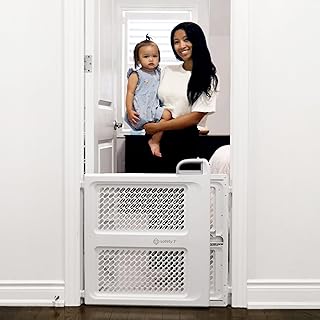
Not all baby gates are interchangeable. A gate designed for a doorway may not be appropriate for the top of a staircase, and a pressure-mounted model should not automatically be treated as equivalent to a hardware-mounted installation.
Pressure-mounted gates are generally convenient for suitable doorways and locations where permanent installation is undesirable. They can be useful when a gate needs to be removed or repositioned. However, the installation location matters enormously. For stair applications, particularly where a fall could occur from the upper level, buyers should carefully follow the manufacturer's installation instructions and select a gate specifically intended for that application.
Hardware-mounted gates are secured to the surrounding structure using mounting hardware. They generally require more installation work, but can provide a more appropriate solution for locations where a securely fixed barrier is necessary. Before purchasing, check whether the mounting surface is suitable and whether the product's instructions specify limitations for drywall, plaster, banisters, angled walls or other unusual configurations.
Measure the opening before buying. Do not rely on an approximate doorway size. Measure at the actual height where the gate will be installed and account for baseboards, trim, banister positioning and other obstructions.
Parents often use safety gates dozens of times during a normal day. A complicated latch can become frustrating, especially when carrying a child, laundry or groceries. Compare the latch mechanism, opening direction, automatic-closing behavior and whether adults can operate it reliably with one hand.
A gate should remain straightforward for adults while being difficult for a young child to defeat. Buyers should also consider whether the gate provides a visual indication that it has closed or latched correctly.
Kitchen and bathroom storage can contain many items that should remain inaccessible to children. Cabinet locks come in several designs, including interior adhesive systems, external latches, magnetic locks and mechanically operated solutions.
Adhesive locks can be attractive to renters because they may avoid drilling into cabinet fronts. However, adhesive performance depends on the surface, cleanliness, temperature, installation method and product design. Before installation, check the manufacturer's surface requirements and curing instructions.
Magnetic systems typically use an internal locking mechanism and an external magnetic key or release device. Their concealed appearance can be useful when maintaining the original appearance of cabinets matters. The key also needs a consistent storage location that remains inaccessible to children but convenient for adults.
Do not limit the assessment to cabinets directly under the sink. Consider drawers and cupboards containing detergents, dishwasher products, medications, batteries, sharp utensils, tools, alcohol-containing products, small objects and other potentially hazardous materials. Some items may be safer when permanently relocated to an inaccessible storage area rather than relying solely on a child-resistant latch.
Furniture tip-over is one of the reasons anchoring deserves special attention in a baby proofing plan. Children may pull on drawers, climb shelving or use furniture as a support while learning to stand and walk. Tall or unstable furniture should be assessed individually.
When comparing furniture safety anchors, examine the intended furniture type, mounting surfaces, hardware supplied, strap or bracket construction and installation instructions. A product is only useful when it is installed correctly into a suitable structural point.
Outlet protection can be useful in rooms where unused electrical receptacles are accessible to children. Buyers should consider whether the product is designed for the specific receptacle configuration in the home and whether adults can remove or operate it without excessive difficulty.
Outlet covers should complement, rather than replace, broader electrical safety practices. Keep cords organized, remove unnecessary extension cords from accessible areas, and avoid leaving chargers or electrical devices where children can pull them down or chew on cables.
Windows require particular attention in homes with elevated floors, balconies or other potential fall hazards. A window safety device should be selected according to the exact window configuration rather than simply choosing a generic product based on appearance.
Before purchasing a window safety product, identify the window style, opening mechanism, frame construction and location. Read the manufacturer's specifications carefully to determine whether the device is compatible. A product intended for one window configuration may not work correctly on another.
Window safety should also include furniture placement. A secured window can still become a concern if a child can climb onto a nearby dresser, chair, bed or storage unit and gain additional height.
Doors can provide access to garages, bathrooms, utility rooms, storage areas, staircases and exterior spaces. Different handles require different safety products, so identify the handle style before shopping.
Staircases should be assessed from both directions. A gate may be needed at the top, bottom or both ends depending on the home's layout and the child's access.
Top-of-stair applications deserve particularly careful attention because incorrect mounting or an unsuitable gate can create a separate hazard. Buyers should follow the manufacturer's instructions precisely and avoid improvising mounting methods.
Open stair railings can also present gaps through which a small child might attempt to pass or become trapped. If the railing configuration creates a concern, choose a purpose-designed safety solution rather than using improvised materials.
Canadian homes can include fireplaces, wood stoves, heaters and other heat-producing equipment. Baby proofing around these areas requires more than simply placing a barrier nearby.
A fireplace guard or hearth barrier should be appropriate for the appliance and arranged so that the child cannot easily reach hot surfaces, controls, firewood, tools or other related objects. Buyers should maintain the manufacturer's required clearances and avoid positioning a child barrier so close to a heat source that the barrier itself becomes unsafe.
Materials matter because safety products can be exposed to repeated pulling, bending, impact, moisture, cleaning and temperature changes. The right material depends on the application.
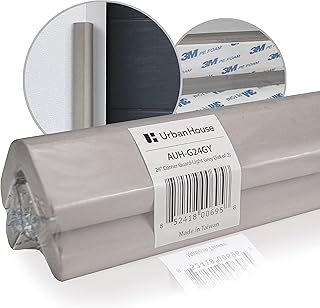
Plastic is common in outlet covers, cabinet locks, corner protectors and gate components. Look for products with clearly specified construction and a design appropriate to the intended use. A soft-looking plastic component is not automatically safer, and a rigid component is not automatically stronger.
Metal is frequently used in gate frames, brackets, screws, anchors and structural components. For hardware-mounted products, pay close attention to the supplied hardware and installation requirements rather than judging strength from appearance alone.
Adhesive mounting can be convenient but is highly dependent on preparation and surface compatibility. Painted, textured, porous, dusty, oily or damp surfaces may behave differently from smooth finished surfaces. Check the manufacturer's instructions before relying on adhesive mounting for an important safety barrier.
Several established brands are commonly associated with child-safety products and can be useful starting points when comparing specifications. Depending on the product category, shoppers may encounter Safety 1st, Dreambaby, Munchkin, Regalo, KidCo, Cardinal Gates, Evenflo and North States.
Brand recognition should not be the only purchasing criterion. Compare the exact model, dimensions, intended application, installation method, compatibility requirements and current manufacturer instructions. A reputable brand can offer several product designs, and one model may be appropriate for your home while another is not.
Safety 1st, Dreambaby and Munchkin offer broad ranges of child-safety products across categories such as gates, cabinet protection and other household safety accessories. When comparing them, focus on the individual product rather than assuming that every item from one brand is superior to every competing product.
Regalo, KidCo and Cardinal Gates are additional names shoppers may encounter when researching safety gates and related child-safety equipment. Their products can differ substantially in dimensions, mounting arrangements, intended locations and features.
For gates in particular, compare the exact width range, gate height, mounting method, extension compatibility, opening mechanism and stated application. These details are more useful than choosing solely on brand familiarity.
A low purchase price does not necessarily represent the best value. The smarter approach is to calculate the complete cost of achieving the required level of coverage.
Deal shopping should begin with the required specification, not with the advertised discount. A large percentage reduction is not useful if the product does not fit the doorway, cabinet, window or furniture being protected.
One of the easiest mistakes is purchasing a gate or lock before measuring the installation area. Even a well-designed product becomes unsuitable if its dimensions do not match the location.
A gate intended for a doorway should not automatically be used at the top of stairs. Always check the manufacturer's stated application and installation requirements.
Adhesive products can be useful for appropriate applications, but buyers should not assume that an adhesive attachment is suitable for every hazard. Follow the instructions and consider the forces the product may experience.
A safety setup that works for a crawling baby may not remain sufficient once the child can stand, pull, climb, open drawers or reach higher surfaces. Baby proofing should evolve with development.
Safety equipment can itself become problematic if installed incorrectly. Loose straps, exposed hardware, unstable barriers, improperly positioned gates and accessible small components should be addressed immediately.
Canadian housing varies considerably, from high-rise apartments and modern condominiums to older detached houses and multi-level properties. The construction of the home can influence which safety products are practical.
Renters may prefer solutions that minimize permanent modifications, but convenience should not override the requirements of the hazard. Where drilling or permanent mounting is restricted, check the lease and consider whether an alternative safety arrangement can provide appropriate protection.
Older homes may have unusual door frames, baseboards, radiators, stair configurations, window designs or wall materials. Measure and inspect the installation location rather than assuming that a standard product will fit.
Product specifications can contain more useful information than marketing descriptions. Before purchasing, look for the following details:
Customer reviews can help identify practical issues that may not be obvious from a product description, but they should be interpreted carefully. Look for repeated comments about the same issue rather than relying on one highly positive or negative review.
For baby gates, useful review themes include difficult installation, latch operation, unexpected fit problems, compatibility with trim and extension requirements. For cabinet locks, look for recurring comments about adhesive performance, installation and ease of adult use. For anchors, focus on installation clarity, hardware compatibility and the type of furniture involved.
Always distinguish between a reviewer's individual installation environment and a general product characteristic. A complaint about fit may result from an unusual doorway, while a repeated complaint across multiple users may indicate a more meaningful concern.
Installing a child-safety product is not necessarily the end of the process. Regular inspection is particularly important for products that are repeatedly opened, closed, pulled or moved.
Replace a safety product when it is damaged, no longer fits correctly, cannot be installed according to the manufacturer's instructions, has missing critical components or no longer provides the intended function. Do not modify a safety product with unapproved hardware or improvised attachments in an attempt to extend its useful life.
It is also sensible to reassess products when moving to a new home. A gate that worked in one doorway may not be suitable for another, and furniture anchors may require a different installation approach after a change in wall construction or furniture placement.
A useful budget starts by separating essential hazard controls from optional convenience products. High-priority items should be selected according to the risks present in the home rather than the number of products included in a bundle.
If you are comparing a list of ten products, use the same evaluation criteria for every option. This makes it easier to distinguish genuine value from attractive but irrelevant features.
Complete baby proofing kits can be convenient when a home needs several basic products at once. They may reduce the effort required to identify individual components, but a kit is not automatically the best choice.
Before purchasing a bundle, create a room-by-room list of actual requirements. A kit containing many outlet covers may be less useful than a smaller collection that includes the correct cabinet locks and furniture anchors your home needs. Conversely, multipacks can be practical when a particular safety component is required throughout the house.
Multi-level homes require a more systematic approach because children can encounter different hazards as they move between floors. Begin with stairs and then evaluate each level independently.
A useful method is to crawl through each room at approximately the child's eye level. Look for accessible cords, low drawers, unstable objects, reachable windows, climbable furniture, electrical outlets, small objects and pathways toward stairs or exterior doors.
There is no single best product for every home. The appropriate choice depends on the hazard, installation location, child’s developmental stage and property layout. A stair gate may be the priority in one home, while furniture anchors, cabinet locks or window safety may deserve greater attention in another.
No. Price alone does not establish suitability. A correctly sized, appropriately installed product that addresses the specific hazard can be a better purchase than a more expensive product with features you do not need. Compare specifications, compatibility, installation requirements and total cost.
Brands such as Safety 1st, Dreambaby, Munchkin, Regalo, KidCo, Cardinal Gates, Evenflo and North States may be worth considering depending on the category. Compare individual models rather than assuming that one brand is universally better.
Measure the opening, determine whether the gate will be used at the top or bottom of stairs or in a doorway, check the mounting method, confirm the supported width, review extension requirements and read the manufacturer's installation instructions.
Adhesive performance depends on the specific product and mounting surface. Follow the manufacturer's preparation and installation instructions exactly and do not assume that an adhesive lock is suitable for every cabinet or drawer.
Assess furniture based on its stability, height, construction, placement and potential for climbing or pulling. Tall, unstable or tip-prone furniture deserves particular attention. Follow the relevant manufacturer's instructions when installing anti-tip hardware.
Inspect frequently used safety products periodically and after furniture is moved, products are reinstalled or components show signs of wear. Gates, latches, straps, brackets and adhesive-mounted locks deserve particular attention because their condition can change through repeated use.
No. Child-safety products are one part of a broader safety strategy. They should be combined with appropriate supervision, safe storage, suitable furniture placement and ongoing reassessment as a child becomes more mobile and independent.
The smartest approach to baby proofing is to buy for the hazards that actually exist in your home. Start with stairs, furniture stability, windows, electrical access, hazardous storage and other high-priority risks. Then add secondary products where they provide meaningful protection.
When comparing the best baby proofing safety deals in Canada, look beyond the advertised price. Check dimensions, installation method, compatibility, package contents, manufacturer instructions, maintenance requirements and current customer feedback. Established names such as Safety 1st, Dreambaby, Munchkin, Regalo, KidCo and Cardinal Gates can provide useful options to compare, but the exact product specification should ultimately determine whether an item suits your home.
Prices, promotions, inventory and product configurations can change throughout 2026. Before making a purchase, verify the latest specifications and current pricing from trusted Canadian retailers and confirm that the product remains suitable for the intended installation location.