

♥ Wishlist
Compare 51 Measuring Wheels for Accurate Distance Measurement products in Canada. Reviews, ratings, pros, cons and buying advice updated for October 2026.




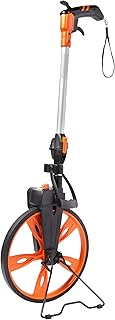


A measuring wheel is a practical alternative to a traditional tape measure when you need to measure longer distances across floors, driveways, sidewalks, lawns, construction sites, roads, landscaping areas or other open spaces. The basic concept is simple: a wheel rolls across a surface while a counter records the distance travelled. However, measuring wheels vary considerably in wheel diameter, counter design, handle construction, portability, terrain capability and measurement accuracy.
For Canadian buyers, the right choice depends on where and how the wheel will be used. A compact measuring wheel can be convenient for indoor renovation work and property measurements, while a larger wheel with a robust frame may be more appropriate for construction, landscaping, surveying-related tasks or repeated outdoor measurements. Metric measurement is particularly useful for Canadian projects, although some models provide both metric and imperial units.
This guide explains the features that matter most when comparing measuring wheels, including wheel size, measurement range, counter readability, reset mechanisms, handle design, folding construction, terrain compatibility and overall durability. The aim is to help you compare specifications and customer feedback carefully rather than choosing a model simply because it has a low advertised price.
A measuring wheel, sometimes called a distance wheel, survey wheel or road measuring wheel, is a handheld distance-measuring tool with a calibrated wheel connected to a mechanical or electronic counter. As the wheel rotates, the counter converts the number of rotations into a distance measurement.
Unlike a short tape measure, a measuring wheel can cover substantially longer distances without requiring the user to repeatedly extend, retract and reposition a tape. This makes it useful when measuring spaces where a straight tape would be inconvenient.
Common applications include:
A measuring wheel should not automatically be treated as a replacement for professional surveying equipment. Its practical accuracy depends on the wheel design, calibration, surface conditions and how consistently the operator keeps the wheel in contact with the intended measurement path.
Compact models are designed for portability and convenient storage. They can be useful for homeowners, DIY users, flooring measurements and indoor work where carrying a larger wheel would be unnecessary.
The main advantage is convenience. A compact wheel is easier to transport and may fit into a toolbox, vehicle or storage cupboard. The trade-off is that smaller wheels can be less comfortable on rough outdoor surfaces.
These models typically combine a larger wheel with a longer handle and a more substantial frame. They are suitable for users who expect to measure larger areas regularly and want a more stable rolling experience.
A professional-style design can also be easier to use for longer measuring sessions because the handle allows the operator to maintain a more natural walking position.
Large wheels are particularly useful when the measurement path contains uneven ground, gravel, grass or other outdoor surfaces. The larger circumference can help the wheel roll over small irregularities more smoothly than a very small wheel.
However, larger wheels can increase the overall size of the tool. Storage and transportation should therefore be considered before choosing one.
Mechanical measuring wheels use a physical counter to record distance. They are straightforward to operate and do not depend on batteries for the basic counting function.
For many users, mechanical simplicity is an advantage. There are fewer electronic features to configure, and the measurement display can be read directly while working.
Digital measuring wheels use an electronic display and may offer additional functions depending on the model. Features can include unit selection, memory functions, easier-to-read numerical displays or additional measurement modes.
Digital functionality can be useful when precise numerical information needs to be viewed quickly. However, buyers should check battery requirements, display visibility, controls and environmental resistance rather than assuming that more electronic features automatically mean better performance.
Wheel diameter is one of the most important specifications because it influences how the measuring wheel behaves across different surfaces.
A smaller wheel is generally easier to transport and manoeuvre. It can work well for indoor measurements and relatively smooth surfaces. A larger wheel may provide better rolling characteristics across outdoor terrain.
When comparing models, consider the surface first rather than choosing the largest wheel available. For smooth floors, a compact design may be sufficient. For lawns, gravel, pavement and construction environments, a larger and sturdier wheel may be more practical.
The wheel material affects durability, traction and rolling behaviour. Common designs use materials such as plastic, rubber or combinations of different materials.
A rubberised wheel can provide useful grip on many surfaces, while a hard plastic wheel may be lightweight and easy to clean. The best option depends on the intended environment.
Look carefully at the product specifications and construction details instead of judging wheel quality solely by appearance.
Measurement range indicates how far the counter can record before reaching its maximum display or requiring a reset. Buyers who measure large properties, paths or commercial areas should pay particular attention to this specification.
A high measurement capacity is useful, but it should be considered alongside readability and reset convenience. A tool that supports the required distance but is awkward to reset or read may be less convenient in everyday use.
Canadian buyers may encounter measuring wheels displaying metres, centimetres, feet or other units. Metric measurements are commonly relevant to Canadian building, landscaping and renovation projects, while imperial measurements can still appear in existing plans, property information and product specifications.
If you regularly work with both systems, a model offering convenient unit selection can reduce conversion work and help prevent measurement errors.
A measuring wheel is only useful if the measurement can be read easily. Examine the size and position of the counter or digital display.
A clearly visible display is particularly important when working outdoors, wearing gloves or measuring while walking. Mechanical counters should also be easy to inspect without forcing the user to stop repeatedly.
A simple reset mechanism saves time when taking multiple measurements. Depending on the design, the reset may be located near the counter or integrated into the handle.
Before buying, consider whether the reset can be operated quickly and whether it is easy to understand without repeatedly checking instructions.
Handle design directly affects comfort. A handle that is too short may force the user to bend forward, while an excessively long handle can make the wheel awkward to control.
Adjustable handles can be particularly useful when several people use the same measuring wheel. Folding handles can also make transportation easier.
A comfortable grip becomes increasingly important when measuring long distances. Look for a handle that can be controlled securely without requiring excessive hand pressure.
If the tool will be used in cold Canadian weather, consider whether the grip can be comfortably operated while wearing work gloves.
Some measuring wheels include a kickstand that allows the tool to remain upright when not in use. This is a convenience feature rather than a measurement requirement, but it can be useful during repeated measurements.
Foldable measuring wheels are easier to store and transport. This can be valuable for contractors, tradespeople, property managers and homeowners who keep tools in a vehicle.
When evaluating a folding design, check the locking mechanism and overall construction. A compact storage size is useful only when the folding mechanism remains secure during operation.
Surface conditions should be one of the first considerations when selecting a measuring wheel in Canada. A measurement taken across a smooth indoor floor presents different demands from a measurement taken across grass, gravel, packed soil or uneven pavement.
On smooth surfaces, a smaller wheel can offer excellent manoeuvrability. On uneven outdoor terrain, a larger wheel may roll over minor surface changes more effectively.
Snow and loose material require additional caution. A conventional measuring wheel is designed to roll along a surface, so deep snow, mud or heavily uneven ground can affect contact with the intended path and therefore influence the result. If the measurement is important, use a suitable measurement method and repeat the measurement to verify the result.
Marketing descriptions often use terms such as accurate, precise or professional. Those descriptions should be considered alongside the actual design and intended application.
A measuring wheel records the distance represented by its rotation. Anything that changes the wheel's effective path can influence the measurement. Examples include slipping, bouncing, lifting the wheel from the ground, changing direction, crossing deep surface irregularities or failing to follow the intended measurement line.
For better consistency:
For ordinary DIY and planning tasks, a well-maintained measuring wheel can be extremely convenient. For legal boundaries, engineering work or professional surveying, buyers should understand the limitations of consumer measuring wheels and use equipment appropriate to the required level of accuracy.
The choice between mechanical and digital measurement is primarily about usability and features rather than simply assuming one technology is universally superior.
Construction users typically need a measuring wheel that can tolerate frequent handling and repeated measurements. Important characteristics include a sturdy frame, reliable wheel construction, a comfortable handle, an easy-to-read counter and a practical reset mechanism.
Brands such as Stanley, Bosch, Milwaukee, DeWalt and Komelon offer a range of measurement and jobsite-oriented tools, although the exact capabilities vary by model. Always compare the specifications of the individual product rather than assuming that every measuring tool from a particular brand has the same construction.
For construction applications, also consider whether the tool needs to fit into a vehicle, tool bag or jobsite storage system. A rugged measuring wheel that is unnecessarily large may be less convenient than a compact model for users who frequently move between locations.
Landscaping measurements can involve lawns, pathways, garden beds, driveways and irregular outdoor areas. A wheel with suitable outdoor rolling characteristics is therefore more important than an ultra-compact indoor design.
Look for:
When measuring curved landscaping features, remember that the wheel follows the path you physically travel. Keep the wheel aligned with the centre of the intended measurement route to produce repeatable results.
Homeowners rarely need the same features as someone using a measuring wheel every day on a commercial site. Portability, ease of use and reasonable durability may therefore be more important than heavy-duty construction.
A compact wheel can be particularly convenient for measuring rooms, garages, driveways, fencing distances and garden areas. A folding handle can make storage easier, especially when the tool is used only occasionally.
For DIY projects, consider buying a model that is simple enough for occasional use but has a clear counter and dependable construction. Paying for specialised features that will never be used does not necessarily provide better value.
Build quality is more than the appearance of the frame. Examine the relationship between the wheel, axle, counter mechanism, handle and folding joints.
A rigid frame can help maintain predictable wheel alignment. Inspect product specifications for the materials used and consider whether the design appears appropriate for the intended environment.
The wheel should rotate smoothly without excessive looseness. The connection between the wheel and frame is especially important because it experiences repeated movement during every measurement.
Foldable models introduce additional joints. These can improve portability, but buyers should examine how the handle locks into its working position.
A good counter should register wheel movement consistently and remain readable during use. If customer feedback is available, look for recurring comments about counter reliability rather than relying on a small number of isolated reviews.
The cheapest model may look attractive, but low purchase cost does not automatically represent the best value. Compare construction, wheel size, counter design and intended use before making a decision.
A measuring wheel designed primarily for smooth floors may not be the best choice for gravel, grass or uneven outdoor surfaces. Match the wheel to the environment.
Large wheels can be useful outdoors, but they also require more storage space. If most measurements are indoors, a compact model may be more practical.
Always check which units the counter displays. Having to repeatedly convert measurements can introduce unnecessary mistakes.
Handle length and grip design can make a substantial difference during repeated measurements. A technically capable wheel may still be inconvenient if its handle is uncomfortable.
A consumer measuring wheel is useful for many practical measurements, but it should not automatically be considered equivalent to professional surveying equipment. Choose equipment according to the accuracy requirements of the project.
Measure the folded dimensions if storage space is limited. A tool that does not fit conveniently into your vehicle or workshop can become frustrating to use.
Customer reviews can provide useful information, but they should be interpreted carefully. Instead of focusing only on the overall star rating, look for recurring comments about the specific features that matter to your application.
Useful review topics include:
When comparing reviews, give more weight to feedback from customers using the tool in conditions similar to your own. A homeowner measuring a garage does not necessarily have the same requirements as a contractor measuring outdoor construction areas every day.
Several established tool brands have measuring and distance-measurement products worth considering when shopping in Canada. Stanley is well known for hand tools and measuring equipment, while Bosch, Milwaukee and DeWalt have extensive tool portfolios aimed at professional and trade users. Komelon is another name buyers may encounter in measuring tools.
The brand should be treated as one comparison factor rather than the final decision. Product quality, specifications, intended application, user feedback and current retailer information should all be considered before purchasing.
A tape measure remains the better option for many short-distance measurements, particularly where exact point-to-point positioning is important. Measuring wheels become more convenient as the distance increases or when the measurement path is easier to walk than to physically stretch a tape.
Many DIY users benefit from keeping both tools available rather than treating one as a universal replacement for the other.
A laser distance measurer offers a very different measurement method. It measures the distance between defined points without requiring the user to physically travel the entire path.
A measuring wheel can be more practical when the intended measurement follows a path across a floor, lawn or road. A laser tool may be more convenient for direct line-of-sight measurements between accessible surfaces.
The choice should therefore be based on the geometry and environment of the measurement rather than simply selecting the newest technology.
For curved paths, follow the centreline or specific route that the measurement is intended to represent. For straight measurements, maintain a straight path wherever practical.
Consistency is often more important than simply having a feature-rich measuring wheel. Two measurements taken using different paths can produce different results even when the measuring wheel itself is functioning correctly.
For repeat measurements, mark the start and finish points clearly. Use the same route each time and maintain similar wheel contact with the surface. If the result appears unexpected, repeat the measurement in the opposite direction or use a second measurement method for comparison.
Measuring wheels are relatively simple tools, but routine care can help maintain reliable operation.
Do not apply lubricants or cleaning products to electronic or mechanical components unless the manufacturer's instructions permit them.
Cold temperatures can change the practical conditions under which a measuring wheel is used. Gloves can make small controls harder to operate, while ice, snow, slush and frozen ground can make rolling less predictable.
When measuring outdoors during winter, focus on stable wheel contact and avoid interpreting measurements across surfaces where the wheel cannot roll consistently. For critical measurements, verify the result using another suitable method.
Prioritise portability, simple operation, a readable counter and reasonable durability. A compact or folding model can be more useful than a large professional-style wheel if storage space is limited.
Prioritise durability, comfortable handling, dependable counting, a suitable wheel diameter and convenient transportation. Frequent users should pay particular attention to frame construction and wheel durability.
Focus on outdoor rolling performance, wheel size, grip and handling across grass, paths and other common landscaping surfaces.
A versatile model with good portability and a clear counter can be useful when measuring multiple buildings, parking areas, walkways and outdoor spaces.
Look for a design that is easy to operate repeatedly and has a counter that remains visible while moving. Consider storage and transportation requirements if the wheel is shared between locations.
A smart buy is not necessarily the least expensive measuring wheel or the model with the greatest number of features. Instead, value comes from matching the tool to the user's actual requirements.
A practical value assessment should consider:
A moderately priced model with the right features can offer better practical value than a more expensive product with functions you never use.
When comparing several models, create a simple specification checklist. This makes it easier to distinguish meaningful differences from marketing language.
A discount should not be the only reason to select a measuring wheel. Deal pages and retailer listings can change, so compare the current product specifications and total purchase conditions before making a decision.
When comparing deals in Canada, examine the exact model number rather than assuming that products with similar names have identical specifications. Check the wheel diameter, measurement capacity, construction, included components and warranty information where provided by the manufacturer or retailer.
Also compare the price against competing models with similar specifications. A slightly higher-priced product may provide better value if it offers a more suitable wheel, stronger construction or features that genuinely matter to your intended application.
There is no single best measuring wheel for every Canadian buyer. The right choice depends on your measurement distance, surface, required portability, preferred measurement units, frequency of use and budget. Compare specifications and verified customer feedback for the individual models you are considering.
Measuring wheels can provide useful and repeatable distance measurements when used correctly. Accuracy can be affected by wheel contact, terrain, slipping, uneven surfaces, operator technique and the condition of the tool. For professional surveying or legally significant measurements, use equipment appropriate to those requirements.
Not necessarily. A larger wheel can be advantageous on some uneven outdoor surfaces, while a smaller wheel can be easier to manoeuvre and store. Choose the diameter according to the surfaces and distances you normally measure.
Digital models can offer additional features and numerical displays, while mechanical models provide simple operation without relying on an electronic display. Neither type is automatically better for every application.
Many measuring wheels can be used on grass, but performance depends on the wheel design and grass conditions. Long, wet, soft or uneven grass can make maintaining consistent wheel contact more difficult.
A suitable outdoor measuring wheel can be used on some gravel surfaces. Loose or highly uneven gravel can affect rolling consistency, so important measurements should be repeated and verified.
Many models support metric measurements, but the available units vary by product. Check the individual specification before purchasing if metres or centimetres are essential to your work.
Yes. A measuring wheel can be convenient for estimating fence-line distances and planning material quantities. For property boundaries or legally significant dimensions, verify measurements using an appropriate professional method.
There is no universal outdoor wheel size. Larger wheels can generally be more suitable for navigating irregular surfaces, while smaller wheels may be easier to transport and manoeuvre. Consider your actual terrain before selecting a size.
Prioritise sturdy construction, a suitable wheel, reliable counting, comfortable handling, useful measurement capacity and a design appropriate for repeated use. Also consider portability if the tool must be transported between job sites.
Yes. They can be particularly useful for measuring driveways, gardens, rooms, flooring areas, fencing distances and other spaces where a tape measure is inconvenient.
Keep the wheel clean, inspect it for wear, maintain consistent wheel contact with the surface and follow the manufacturer's maintenance instructions. Recheck important measurements rather than relying on a single pass.
The best measuring wheel is the one that fits the measurement task rather than simply the one with the longest list of features. Start by identifying where you will use it, how far you need to measure and which surfaces you will encounter. Then compare wheel diameter, wheel material, counter design, measurement units, handle construction, portability and customer feedback.
For occasional DIY work, simplicity and storage convenience may be the most important factors. For professional or repeated use, durability, comfort and reliable operation deserve greater attention. Outdoor users should give particular consideration to wheel size and terrain compatibility.
When comparing the top measuring wheel deals available in Canada in 2026, verify the current specifications for each model and distinguish genuine product differences from variations in retailer descriptions. Read recent customer feedback where available, compare similar models on a like-for-like basis and check the manufacturer's stated capabilities before purchasing.
A careful comparison can help you choose a measuring wheel that is easier to use, appropriate for your working environment and capable of providing consistent measurements for the projects you actually undertake.